
IBM Data & AI Watsonx.AI
IBM Watsonx AI
The only AI studio you need
IBM watsonx.ai™ is an integrated AI development studio that makes building and deploying AI simple and scalable. It includes APIs, tools, customizable models, and flexible runtimes ready for use in any cloud or hybrid environment.
Reliable foundation models tailored to your needs
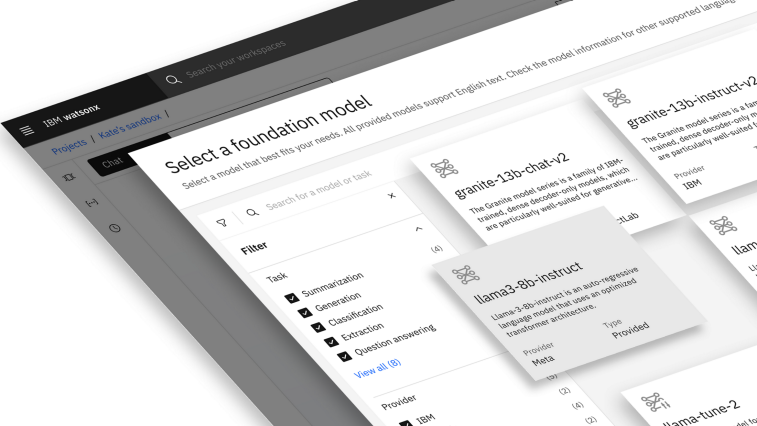
Access business-ready foundation models through Model Gateway. Choose from IBM Granite, third-party models, and open-source options from platforms like Hugging Face and partners such as Meta, tailored to your needs and ready to scale with your business.
Build with ease
Produce powerful AI solutions with user-friendly interfaces, workflows and access to industry-standard APIs and SDKs.
Find it all in the integrated studio
Get one-stop access to capabilities that span the AI development lifecycle with built-in performance and scalability.
Collaborate in a gen AI toolkit
Unlock innovations for the AI builder through a collaborative development experience with or without code.
Work and deploy where you want
Quickly build, run and manage gen AI applications in the hybrid cloud platform of your choice.
Real clients. Real results.
AddAI saw 50% fewer unanswered customer service queries

Silver Egg Technology anticipates a 75% faster hiring process

UHCW NHS Trust had 700 more patients seen weekly without adding staff

Blendow Group saw 90% less time needed to summarize and analyze documents
Simplify your data lifecycle
Streamline the application development process
This comprehensive suite of developer-focused capabilities, preconfigured SDKs, APIs, agentic workflows, retrieval augmented generation (RAG) frameworks and templates, advanced tuning methods and more, helps bring your AI application development process together in natural language or code. Explore AI agent development on watsonx.ai.
Manage the full model and application process
No need to scramble to pull together what you need for model training and generative AI development. Access a variety of powerful, low-cost, fit-for-purpose models, MLOps pipelines and AI runtimes that reside in one place for more efficient building of powerful applications with trusted data and built-in governance, that you can effectively manage, monitor and govern across the AI lifecycle.
Access a robust data science toolset
Bring generative AI and machine learning into production faster. Build AI/ML models automatically with model training, development and visual modeling, and synthetic data generation. You can also develop predictive and prescriptive models, code in Python Notebooks or Rstudio, or work directly in your IDE of choice.